AAWSAP DIRD, Quantum Computing and Utilizing Organic Molecules in Automation Technology, December 2010
DOW-UAP-D150 · page 18 of 54
Text
This text came with the file. It may have mistakes. When the text and the image disagree, the image is right.
UNCLASSIFIED//FOR. OFFI@IAI: l48E OHi:¥
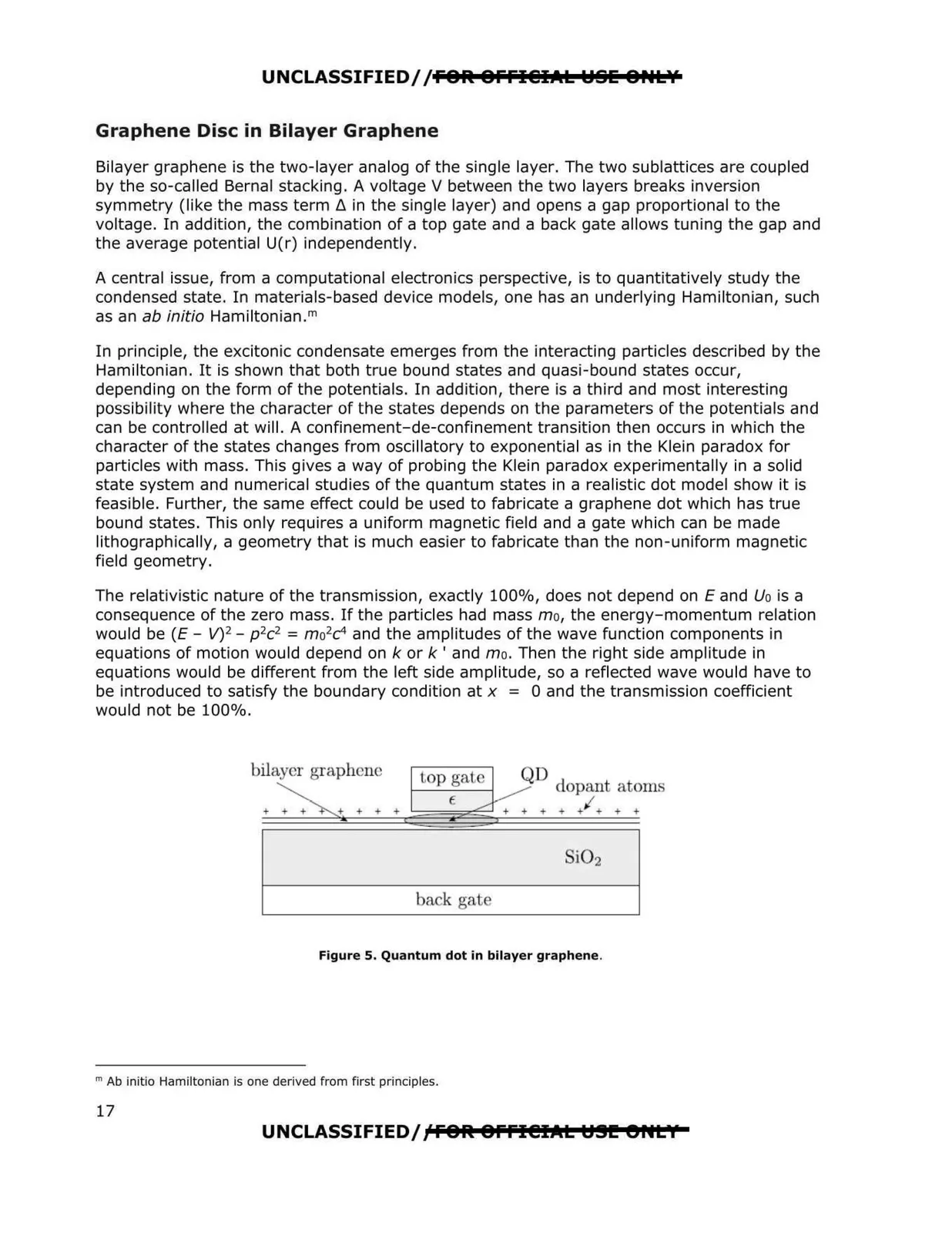
Graphene Disc in Bilayer Graphene
Bilayer graphene is the two-layer analog of the single layer. The two sublattices are coupled
by the so-called Bernal stacking. A voltage V between the two layers breaks inversion
symmetry (like the mass term ti in the single layer) and opens a gap proportional to the
voltage. In addition, the combination of a top gate and a back gate allows tuning the gap and
the average potential U(r) independently.
A central issue, from a computational electronics perspective, is to quantitatively study the
condensed state. In materials-based device models, one has an underlying Hamiltonian, such
as an ab initio Hamiltonian .m
In principle, the excitonic condensate emerges from the interacting particles described by the
Hamiltonian. It is shown that both true bound states and quasi-bound states occur,
depending on the form of the potentials. In addition, there is a third and most interesting
possibility where the character of the states depends on the parameters of the potentials and
can be controlled at will. A confinement-de-confinement transition then occurs in which the
character of the states changes from oscillatory to exponential as in the Klein paradox for
particles with mass. This gives a way of probing the Klein paradox experimentally in a solid
state system and numerical studies of the quantum states in a realistic dot model show it is
feasible. Further, the same effect could be used to fabricate a graphene dot which has true
bound states. This only requires a uniform magnetic field and a gate which can be made
lithographically, a geometry that is much easier to fabricate than the non-uniform magnetic
field geometry.
The relativistic nature of the transmission, exactly 100%, does not depend on E and Vo is a
consequence of the zero mass. If the particles had mass mo, the energy-momentum relation
would be (E - V) 2 - p 2c2 = mo2c4 and the amplitudes of the wave function components in
equations of motion would depend on k or k' and mo. Then the right side amplitude in
equations would be different from the left side amplitude, so a reflected wave would have to
be introduced to satisfy the boundary condition at x = 0 and the transmission coefficient
would not be 100%.
bilayer
aph · ne
op gat
f
+ + + +
+ + + +
Figure 5. Quantum dot in bilayer graphene.
m Ab initio Hamiltonian is one derived from first principles.
UNCLASSIFIED/;'FOR. 8FFl@IAL U9I!! eHt I
17