AAWSAP DIRD, Cognitive Limits on Simultaneous Control of Multiple Unmanned Spacecraft, December 2010
DOW-UAP-D151 · page 18 of 31
Text
This text came with the file. It may have mistakes. When the text and the image disagree, the image is right.
UNCLASSIFIED//FOR 8FFl@IAL li!H!! 8HL I
crash any planes in any of the scenarios - this required approximately 6 hours of
practice per participant before the experiment was conducted .
Only one of the eight controllers in the Brookings study rated the overload condition as
a loss of situational awareness. The results compared the TLX, primary task
performance, and physiological measures to low, medium, and high workload conditions,
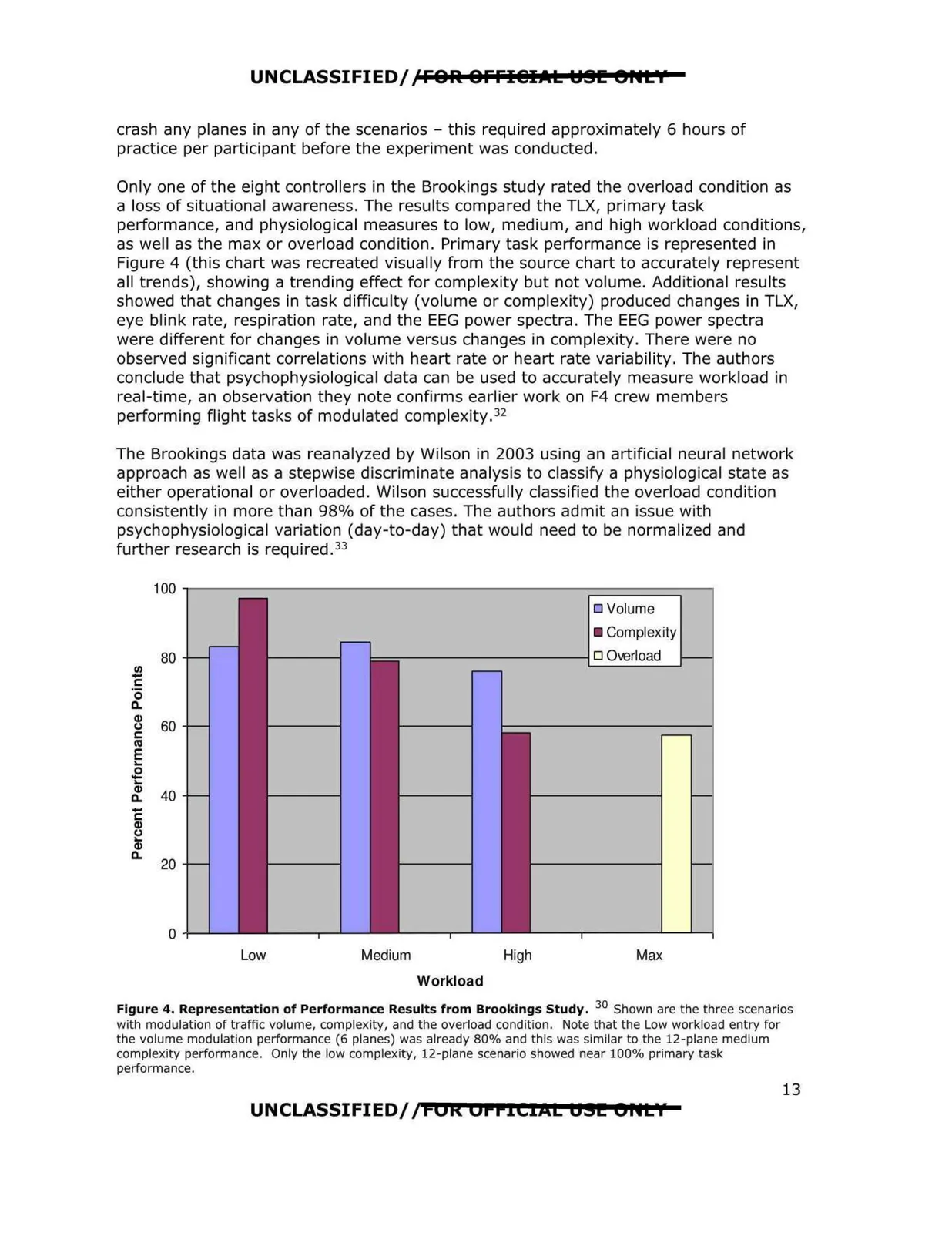
as well as the max or overload condition. Primary task performance is represented in
Figure 4 (this chart was recreated visually from the source chart to accurately represent
all trends), showing a trending effect for complexity but not volume. Additional results
showed that changes in task difficulty (volume or complexity) produced changes in TLX,
eye blink rate, respiration rate, and the EEG power spectra. The EEG power spectra
were different for changes in volume versus changes in complexity. There were no
observed significant correlations with heart rate or heart rate variability. The authors
conclude that psychophysiological data can be used to accurately measure workload in
real-time, an observation they note confirms earlier work on F4 crew members
performing flight tasks of modulated complexity. 32
The Brookings data was reanalyzed by Wilson in 2003 using an artificial neural network
approach as well as a stepwise discriminate analysis to classify a physiological state as
either operational or overloaded. Wilson successfully classified the overload condition
consistently in more than 98% of the cases. The authors admit an issue with
psychophysiological variation (day-to-day) that would need to be normalized and
further research is required. 33
100
□ Volume
■ Complexity
80
□ Overload
Ill-
C ·o
a.
G)
60
(J
C
ca
E
~
0-
~
G)
40
C.-
C
G)
(J
~
G)
C.
20
Low
Medium
High
Max
Workload
Figure 4. Representation of Performance Results from Brookings Study. 30 Shown are the three scenarios
with modulation of traffic volume, complexity, and the overload condition. Note that the Low workload entry for
the volume modulation performance (6 planes) was already 80% and this was similar to the 12-plane medium
complexity performance. Only the low complexity, 12-plane scenario showed near 100% primary task
performance.
UNCLASSIFIED/ JFOR OFFICIAL 091! er•tY
13