AAWSAP DIRD, Cognitive Limits on Simultaneous Control of Multiple Unmanned Spacecraft, December 2010
DOW-UAP-D151 · page 19 of 31
Text
This text came with the file. It may have mistakes. When the text and the image disagree, the image is right.
UNCLASSIFIED/lfQR OEFICitk W&li 8HLY
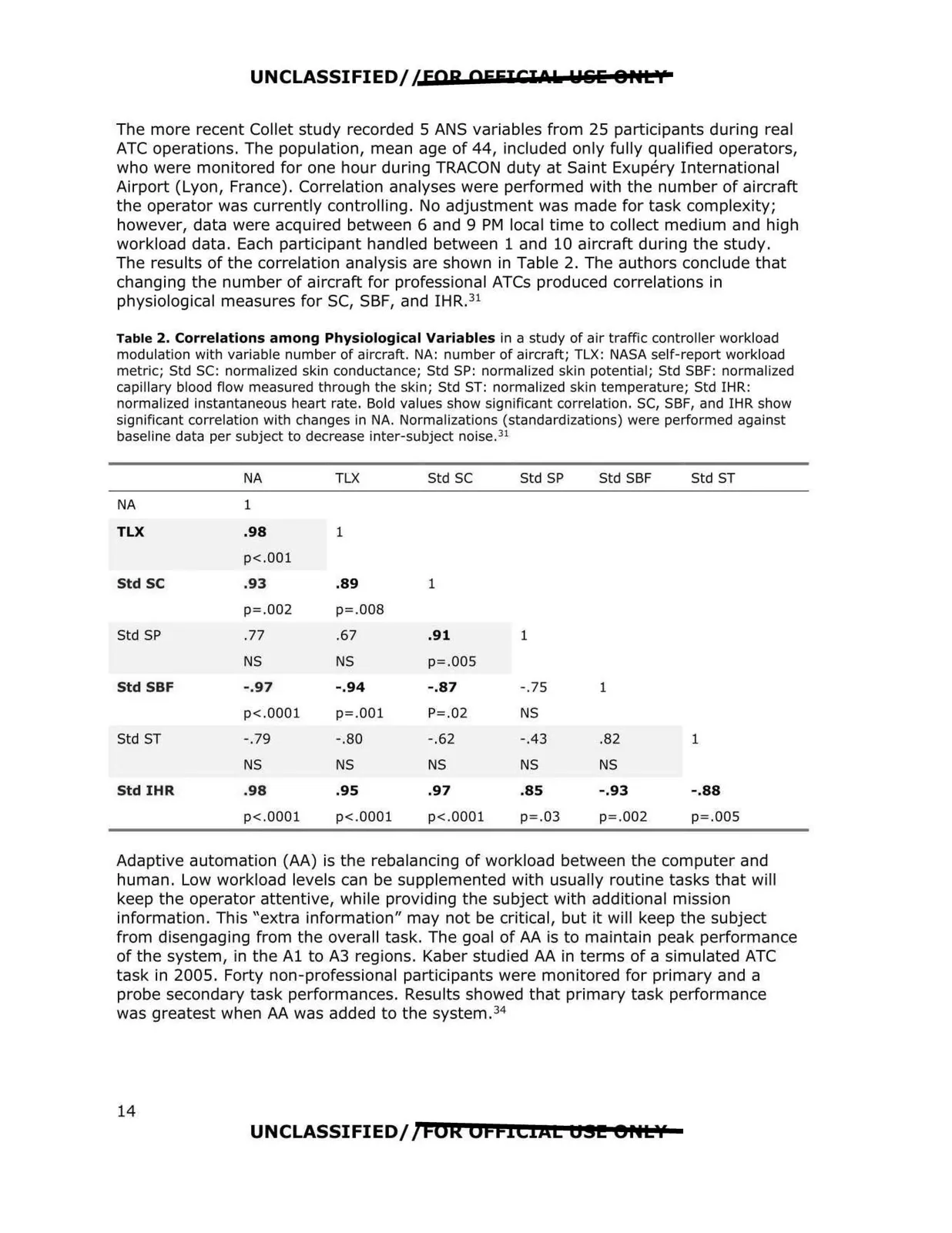
The more recent Collet study recorded 5 ANS variables from 25 participants during real
ATC operations. The population, mean age of 44, included only fully qualified operators,
who were monitored for one hour during TRACON duty at Saint Exupery International
Airport (Lyon, France) . Correlation analyses were performed with the number of aircraft
the operator was currently controlling . No adjustment was made for task complexity;
however, data were acquired between 6 and 9 PM local time to collect medium and high
workload data. Each participant handled between 1 and 10 aircraft during the study.
The results of the correlation analysis are shown in Table 2. The authors conclude that
changing the number of aircraft for professional ATCs produced correlations in
physiological measures for SC, SBF, and IHR. 31
Table 2. Correlations among Physiological Variables in a study of air traffic controller workload
modulation with variable number of aircraft. NA: number of aircraft; TLX: NASA self-report workload
metric; Std SC: normalized skin conductance; Std SP: normalized skin potential; Std SBF: normalized
capillary blood flow measured through the skin; Std ST: normalized skin temperature; Std IHR:
normalized instantaneous heart rate. Bold values show significant correlation. SC, SBF, and IHR show
significant correlation with changes in NA. Normalizations (standardizations) were performed against
baseline data per subject to decrease inter-subject noise. 31
NA
TLX
Std SC
Std SP
Std SBF
Std ST
NA
1
TLX
.98
1
p<.001
Std SC
.93
.89
1
p=.002
p=.008
Std SP
.77
.67
.91
1
NS
NS
p=.005
Std SBF
-.97
-.94
-.87
-.75
1
p<.0001
p=.001
P=.02
NS
Std ST
-.79
-.80
-.62
-.43
.82
1
NS
NS
NS
NS
NS
Std IHR
.98
.95
.97
.85
-.93
-.88
p<.0001
p<.0001
p<.0001
p=.03
p=.002
p= .005
Adaptive automation (AA) is the rebalancing of workload between the computer and
human. Low workload levels can be supplemented with usually routine tasks that will
keep the operator attentive, while providing the subject with additional mission
information. This "extra information" may not be critical, but it will keep the subject
from disengaging from the overall task. The goal of AA is to maintain peak performance
of the system, in the Al to A3 regions. Kaber studied AA in terms of a simulated ATC
task in 2005. Forty non-professional participants were monitored for primary and a
probe secondary task performances. Results showed that primary task performance
was greatest when AA was added to the system. 34
UNCLASSIFIED/ }Fdk OFFICIAL 091!! 8HLY
14