AAWSAP DIRD, Negative Mass Propulsion, January 2011
DOW-UAP-D152 · page 24 of 43
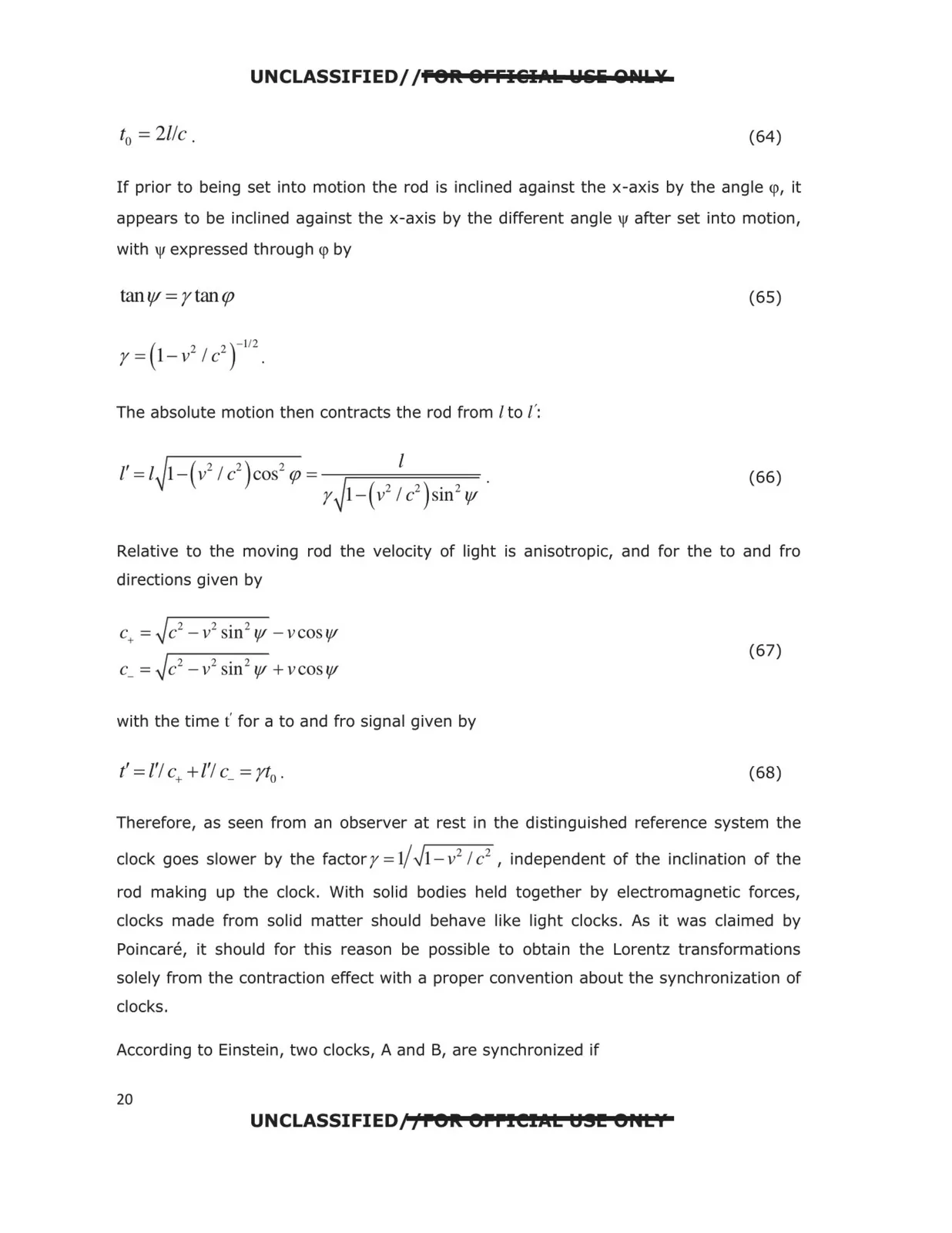
Text
This text came with the file. It may have mistakes. When the text and the image disagree, the image is right.
UNCLASSIFIED/ /P'OR. 8FFIEil1'1.k lellii Ql'II.¥
t0 = 2llc.
(64)
If prior to being set into motion the rod is inclined against the x-axis by the angle <p, it
appears to be inclined against the x-axis by the different angle 'l' after set into motion,
with 'l' expressed through cp by
tan If/ =r tan tp
(65)
(
v2 I c2 )-1/2
y = 1-
.
The absolute motion then contracts the rod from Lto /':
(66)
Relative to the moving rod the velocity of light is anisotropic, and for the to and fro
directions given by
c+ = .Jc2 - v2 sin2 If/ - v cos If/
(67)
C_ =,Jc2 -v2 sin 2 lj/ + VCOSlj/
with the time t' for a to and fro signal given by
t' = l'I c+ +l'I c_ = yt0 .
(68)
Therefore, as seen from an observer at rest in the distinguished reference system the
clock goes slower by the factory = 1/✓1 - v2I c2 , independent of the inclination of the
rod making up the clock. With solid bodies held together by electromagnetic forces,
clocks made from solid matter should behave like light clocks. As it was claimed by
Poincare, it should for this reason be possible to obtain the Lorentz transformations
solely from the contraction effect with a proper convention about the synchronization of
clocks.
According to Einstein, two clocks, A and B, are synchronized if
20
UNCLASSIFIED//P'Olll OPPIEll<L tt!II!! or~LY