AAWSAP DIRD, Negative Mass Propulsion, January 2011
DOW-UAP-D152 · page 39 of 43
Text
This text came with the file. It may have mistakes. When the text and the image disagree, the image is right.
UNCLASSIFIED/ /P'OR. 8FFIEil1'1.k lellii Ql'II.¥
The time needed for the liquid metal to pass through a ~20 m thick layer is then ~2 x
103 seconds ~ 1 hour. The specific heat per unit volume of the coolant is pc., ~ 3 x 10⁷
erg/cm3K, and for T = 3 x 10³ Kone has pc,,T ~ 1011 erg/cm3 .
The heat per unit volume which has to be removed from the crushed rocks is of the
order p, where p is the rock pressure. In the center of the moon where p = 5 x 10¹⁰
2
10
3
,
.
dyn/cm
this energy is 5 x 10
erg/cm It thus follows that the volume of the liquid
coolant must be about ½ of the rock volume to be cooled. For a rock volume of (20
cm) 3 ~ 104 m3, a coolant volume of about 5 x 103 cm 3 would be needed. The same
coolant can be used many times over after the heat is removed from it, which could be
done on the surface of the moon by radiation or perhaps better by heat exchangers
transferring the heat to lunar sand. Without a thick layer of shattered rocks surrounding
the tunnel, the pressure acting on the tunnel wall would be large, in particular in the
center of the moon. Because of friction between particles of the shattered rock, large
shear stresses can be sustained changing the pressure distribution in the rock and
reducing the pressure gradient and hence the pressure on the tunnel wall.
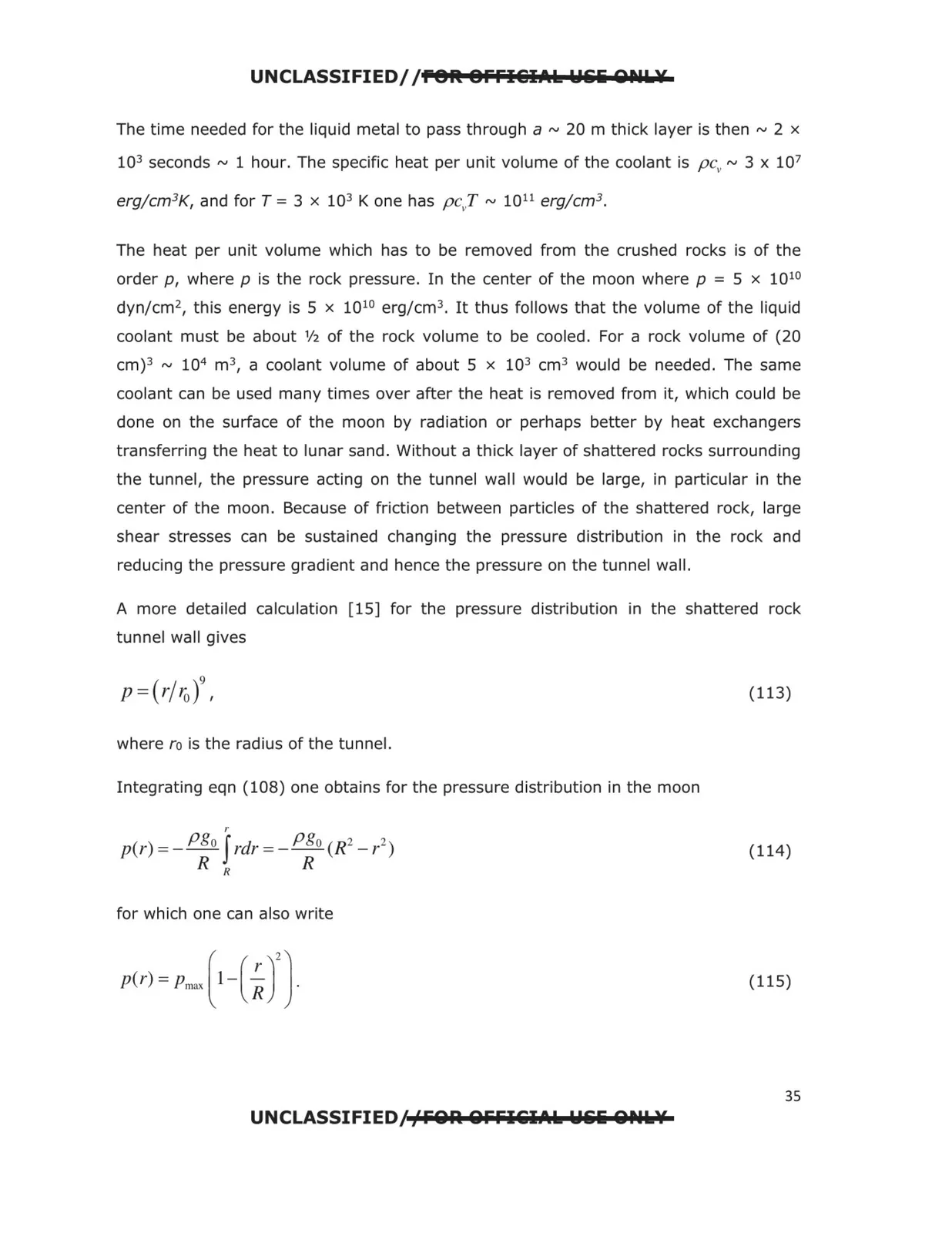
A more detailed calculation [15) for the pressure distribution in the shattered rock
tunnel wall gives
p = (r/ro)9,
(113)
where ro is the radius of the tunnel.
Integrating eqn (108) one obtains for the pressure distribution in the moon
,.
p(r) = - pgofrdr = _ Pgo (R2 - r 2)
(114)
R
R
R
for which one can also write
(115)
UNCLASSIFIED/fFOA OFFI&il.t.k lellii OJi,k¥
35