Astronaut Scientific Debriefings, 1962-1963
NASA-UAP-D015 · page 209 of 216
Text
This text came with the file. It may have mistakes. When the text and the image disagree, the image is right.
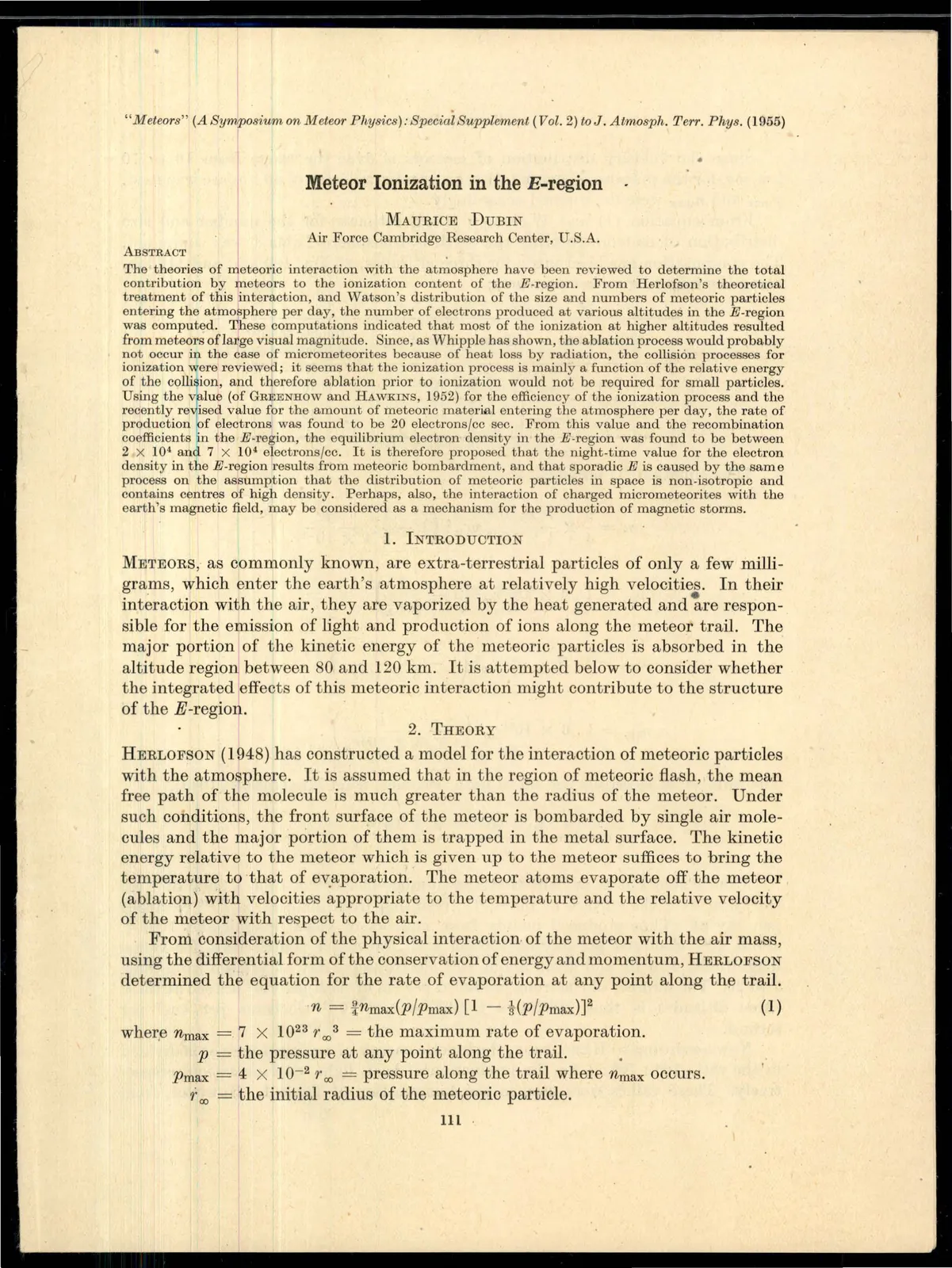
"Meteors" (A Symposium on Meteor Physics): Special Supplement (Vol. 2) toJ. Atmosph. T err. Phys. (1955) Meteor Ionization in the E-region MAURICE DUBIN Air Force Cambridge Research Center, U.S.A. ABSTRACT The theories of meteoric interaction with the atmosphere have been reviewed to determine the total contribution by meteors to the ionization content of the E-region. From Herlofson's theoretical treatment of this interaction, and Watson's distribution of the size and numbers of meteoric particles entering the atmosphere per day, the number of electrons produced at various altitudes in the E-region was computed. These computations indicated that most of the ionization at higher altitudes resulted from meteors oflarge visual magnitude. Since, as Whipple has shown, the ablation process would probably not occur in the case of micrometeorites because of heat loss by radiation, the collision processes for ionization were reviewed; it seems that the ionization process is mainly a function of the relative energy of the co11·'ion, and therefore ablation prior to ionization would not be required for small particles. Using the Jue (of GREENHOW and H AWKINS, 1952) for the efficiency of the ionization process and the recently re ised value for the amount of meteoric material entering the atmosphere per day, the rate of production f electrons was found to be 20 electrons/cc sec. From this value and the recombination coefficients ·n the E-region, the equilibrium electron density in the E-region was found to be between 2 x 10⁴ and 7 x 10⁴ electrons/cc. It is therefore proposed that the night-time value for the electron density in the E -region results from meteoric bombardment, and that sporadic Eis caused by the same process on the assumption that the distribution of meteoric particles in space is non-isotropic and contains centres of high density. P erhaps, also, the interaction of charged micrometeorites with the earth's magnetic field, may be considered as a mechanism for the production of magnetic storms. 1. INTRODUCTION METEORS, as commonly known, are extra-terrestrial particles of only a few milli grams, which enter the earth's atmosphere at relatively high velocities. In their interaction with the air, they are vaporized by the heat generated and ~re respon sible for the emission of light and. production of ions along the meteor trail. The major portion of the kinetic energy of the meteoric particles is absorbed in the altitude region between 80 and 120 km. It is attempted below to consider whether the integrated effects of this meteoric interaction might contribute to the structure of the E-region. 2. THEORY HERLOFSON (1948) has constructed a model for the interaction of meteoric particles with the atmosphere. It is assumed that in the region of meteoric flash, the mean free path of the molecule is much greater than the radius of the meteor. Under such conditions, the front surface of the meteor is bombarded by single air mole cules and the major portion of them is trapped in the metal surface. The kinetic energy relative to the meteor which is given up to the meteor suffices to bring the temperature to that of ev:aporation. The meteor atoms evaporate off the meteor (ablation) with velocities appropriate to the temperature and the relative velocity of the meteor with respect to the air. From consideration of the physical interaction.of the meteor with the air mass, using the differential form ofthe conservation ofenergyand momentum, HERLOFSON determined the equation for the rate of evaporation at any point along th!;) trail. r n = ¾nmax(P/Pmax) [l - ¼(P/Pmax)]2 (1) wher.e nmax = 7 X 10²³ r 00 3 = the maximum rate of evaporation. p = the pressure at any point along the trail. Pmax = 4 X 10- 2 r 00 = pressure along the trail where nmax occurs. 00 = the initial radius of the meteoric particle. 111