Astronaut Scientific Debriefings, 1962-1963
NASA-UAP-D015 · page 210 of 216
Text
This text came with the file. It may have mistakes. When the text and the image disagree, the image is right.
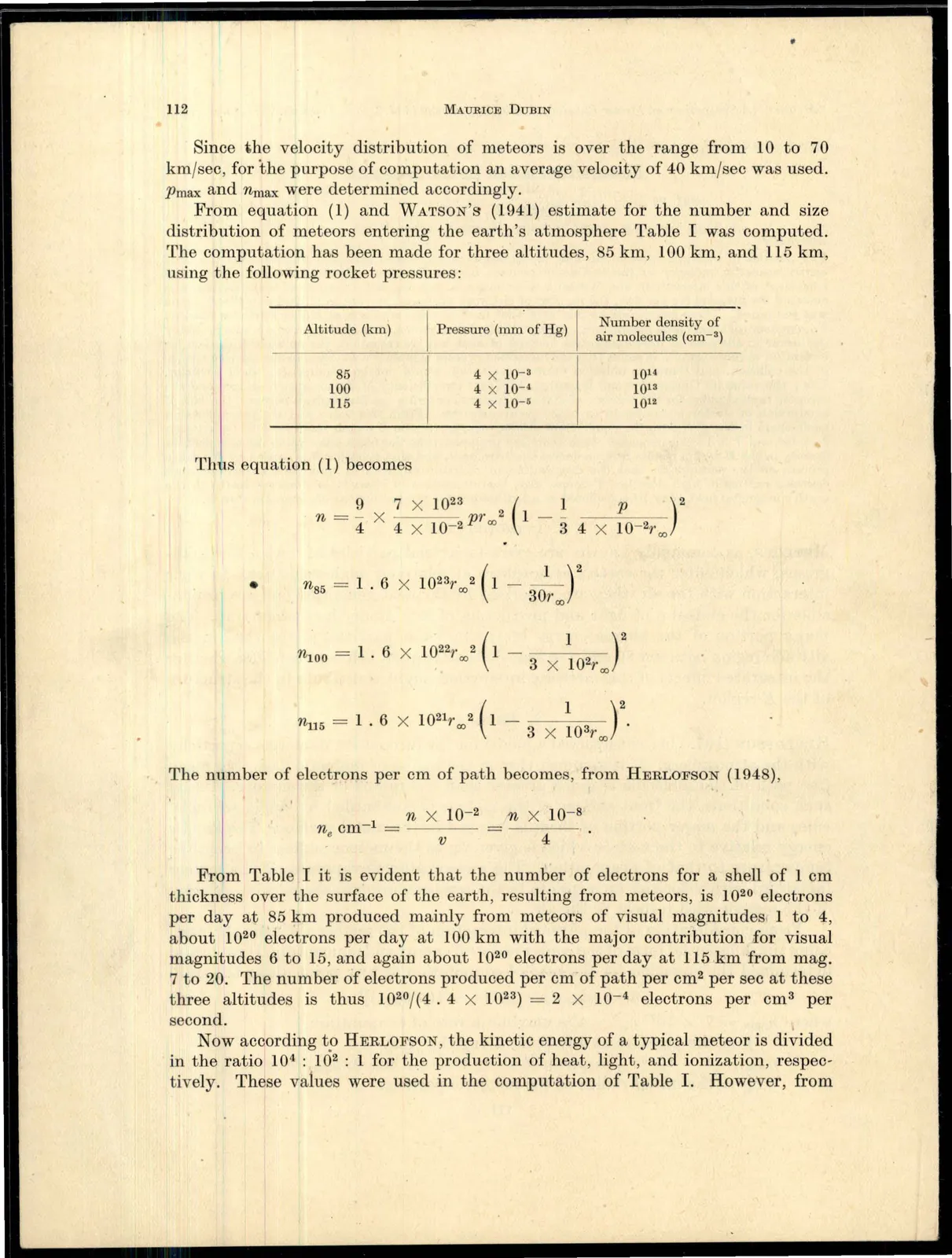
112 MAURICE DUBIN Since the velocity distribution of meteors is over the range from 10 to 70 km/sec, for the purpose of computation an average velocity of 40 km/sec was used. Pmax and nm.a.--.. were determined accordingly. From equation (1) and WATSON'S (1941) estimate for the number and size distribution of meteors entering the earth's atmosphere Table I was computed. The computation has been made for three altitudes, 85 km, 100 km, and 115 km, using the following rocket pressures: Altitude (km) I Pressure (mm.of Hg) Number density of air molecules (cm- •) 85 4 X l0- 3 1014 100 4 X l0- • 10l3 115 4 X 10- 5 1012 Thus equation (1) becomes 7 X 10²³ 9 ( 1 p )2 n = 4 X 4 X 10- 2pra} 1 3 4 X 10- 2r 00 2 = 1.6 x l021 2 ( 1 - l ) • n115 r 00 3 X 10³ 00 r The number of electrons per cm of path becomes, from HERLOFSO (1948), n X 10- 2 n X 10- s n. cm-1 = --- v 4 From Table I it is evident that the number of electrons for a shell of 1 cm thickness over the surface of the earth, resulting from meteors, is 1020 electrons per day at 85 km produced mainly from meteors of visual magnitudes 1 to 4, about 1020 electrons per day at 100 km with the major contribution for visual magnitudes 6 to 15, and again about 1020 electrons per day at 115 km from mag. 7 to 20. The number of electrons produced per cm of path per cm2 per sec at these three altitudes is thus 1020/ ( 4 . 4 x 10²³ ) = 2 x 10- 4 electrons per cm 3 per second. Now according to HERLOFSON, the kinetic energy of a typical meteor is divided in the ratio 104 : 102 : 1 for the production of heat, light, and ionization, respec tively. These values were used in the computation of Table I. However, from